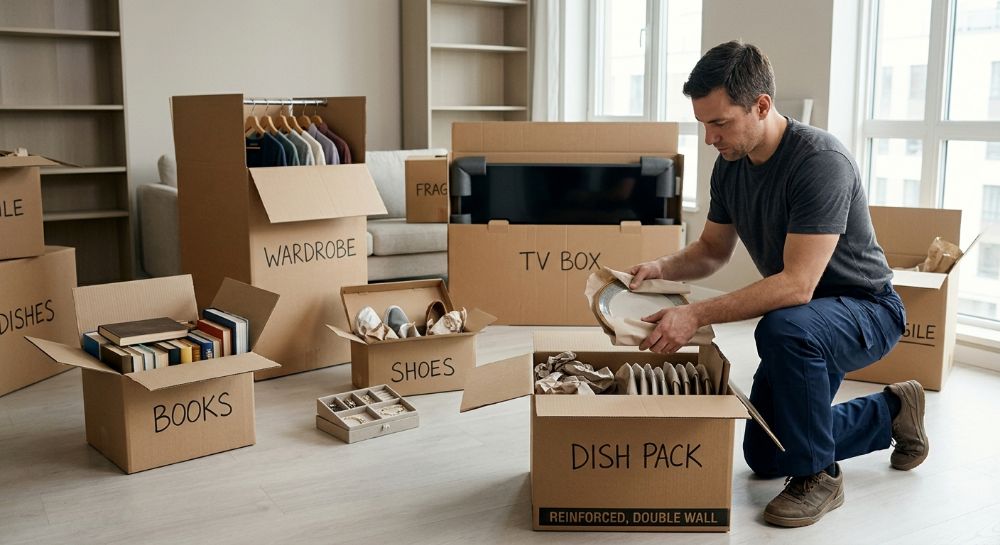
How to pack for a move comes down to matching the box to the item. Dishes need a dish pack box and vertical stacking. Books need small boxes, packed full. Clothes, shoes, and jewelry each need a different method, and TVs need their own box entirely, never a general one.
What Order Should You Pack In?
Pack the rooms you use least first: guest rooms, storage closets, seasonal items. Kitchens and bathrooms go last, since you need them until moving day. If you haven’t sorted through what you actually want to keep, our KonMari decluttering guide for movers is worth doing before any of this starts.
Label every box with its destination room and contents, not just “misc.” That single habit saves more time on the other end than any packing technique below. For a full walkthrough of packing every room in sequence, see our room-by-room packing guide.
How Do You Pack Clothes for a Move?
Hanging clothes go straight into a wardrobe box, still on hangers, no folding required. Everything else gets folded into medium boxes or left in dresser drawers if the dresser itself is moving.
Vacuum-sealed bags work for out-of-season clothing you won’t need for weeks, cutting the volume by roughly half. Don’t vacuum-seal wool or down items long-term, since compression can flatten the loft permanently.
How Do You Pack Dishes for a Move?
Use an actual dish pack box, also called a dish barrel: double-walled cardboard, about 18 by 18 by 28 inches. Standard boxes crush under the weight of stacked plates.
Line the bottom with 2 to 3 inches of crumpled paper. Wrap each plate individually and load them on their edge, like records in a crate, not flat. Flat stacking is the single most common reason plates crack in transit, since the weight above presses straight down on the weakest point of each plate.
Wrap glasses and cups one at a time too. Bundling two together with paper between them still lets them chip against each other over a long drive.
How Do You Pack Books for a Move?
Books belong in small boxes, packed to the top. A large box full of books is too heavy to lift safely, and the box itself often fails first.
Pack them flat, spine down, in tight rows so nothing shifts. Fill any gap at the top with paper rather than leaving books loose.
How Do You Pack Shoes for a Move?
Keep pairs together, stuffed with paper to hold their shape, then boxed by category rather than tossed in loose. A single medium box holds roughly 8 to 10 pairs without crushing them.
Original shoe boxes work fine for anything structured, like heels or dress shoes. Soft shoes and sneakers can go straight into a general box with paper between pairs.
How Do You Pack Jewelry for a Move?
Small pieces get lost fast in a full moving box. Push earring posts through a scrap of foam or thick fabric and secure the backs, so pairs stay matched. A pill organizer works well for rings and small studs, one compartment per piece.
Photograph anything valuable before you pack it. If a piece goes missing or gets damaged, that photo is the only proof you had it in good condition beforehand. The same rule applies to other high-value heirlooms; our guide on moving antique furniture safely covers documentation and coverage for larger pieces.
How Do You Pack a TV for Movers?
Use a TV box, not a general moving box. The original box, if you kept it, is still the best fit since it was built for that exact screen size.
| Box type | Best for | Avoid using for |
| Dish pack (double-wall) | Plates, bowls, glasses | Books, shoes |
| Small box | Books, dense items | Lightweight bulky items |
| Wardrobe box | Hanging clothes | Folded clothing |
| TV box | Flat-screen TVs | Any other fragile item |
Wrap the screen in bubble wrap without letting tape touch the glass. Pad all four corners with foam, then load the TV upright, never flat, and fill remaining space so it can’t shift during the drive.
One case worth knowing: movers report that TVs packed flat inside a moving truck account for a disproportionate share of screen-crack claims, since horizontal loading puts pressure across the panel from whatever gets stacked on top. Upright loading avoids that entirely.
FAQ
Do I need a dish pack box, or will a regular box work? Most moving companies rent dish packs by the day rather than requiring purchase, which is worth asking about if you only need two or three for a small kitchen. Cell dividers that slot inside the box add another layer of protection for stemware specifically, keeping each glass from touching its neighbor. Rental costs vary by mover; see how much movers cost in 2026 for typical pricing.
How many books fit safely in one box? Aim to keep any single box under about 30 pounds once packed, which for most hardcovers works out to somewhere around 15 to 20 books in a small box. Weigh a full box once by hand before you commit to that size for the rest of your library.
Can I use my TV’s original box if I still have it? Yes, and it’s worth keeping around for exactly this reason, most people toss it within a year of buying the TV. Without it, an adjustable TV box from a moving supply store works nearly as well, since it’s built with the same corner cushions and expands to fit different screen widths.
Pack fragile categories, dishes, jewelry, and the TV, on a separate day from everything else, so you’re not rushing the parts of the move most likely to end in a damage claim.
About the Author