You can move most sheds without taking them apart. Small ones can be carried. Bigger ones get rolled on pipes, dragged on skids, or loaded onto a trailer. The right method depends on the shed’s size, how the floor is built, and how far it’s going.
Check the rules for the new spot before you lift anything. Learning about a setback is a lot easier before the shed is already sitting in the wrong place.
Key takeaways
- Four people can usually carry a shed under 100 sq ft. Anything larger needs rollers, skids or a trailer.
- Hiring pros typically costs $200 to $1,000, with the average near $500.
- Many U.S. areas exempt small sheds from building permits, but the size limit ranges from 50 to 1,000 sq ft depending on the state.
- A shed wider than 8.5 ft on a public road will likely need an oversize permit.
Which Shed-Moving Method Fits Your Shed?
Start with the size. Backyard Oasis suggests carrying sheds under 100 sq ft, moving larger ones on rollers, skids or a trailer, and dismantling anything too big or fragile to lift in one piece.
Then look underneath. A shed with runners under the floor is basically built to be moved. On the TractorByNet forum, a man who built sheds for a modular building company in the 1980s said all of theirs had two or three 2×4 or 4×4 runners along the length of the floor. A shed on a slab is harder. Aosom notes that sheds on skids or gravel move more easily, while ones on concrete or bolted down may have to come apart.
| Your situation | Method that usually fits |
|---|---|
| Under ~100 sq ft, short distance, 4 helpers | Carry by hand |
| Medium shed, solid floor with runners, same yard | Rollers |
| Large shed, flat ground, same property | Skid and tow |
| New address or public roads | Trailer or shed mover |
| Rotten, fragile, or on a slab | Take it apart |
Get the Shed Ready Before Anything Lifts
Empty it first. All of it. Angi says the shed has to be completely empty because anything left inside can shift or spill and damage it. A lighter shed is also easier on the floor joists and on you.
Next, look closely at the structure. Poke the floor framing and the bottom of the walls. According to Aosom, a badly damaged shed can collapse partway through the move or need major repairs after. If a screwdriver sinks into the wood, stop and rethink the plan.
The route matters too. Aosom’s advice is to clear debris, cut back low branches, look for power lines, check how steep and firm the ground is, and put plywood over soft spots. Measure your gates. An 8-ft-wide shed and a 7-ft gap between two trees are a problem you want to find on paper.
If the shed has wiring, have an electrician disconnect it. HomeAdvisor’s process ends with bringing an electrician back to reconnect the power after the shed is placed.
Make sure the new spot is level before the shed gets there. Angi lists a concrete slab or concrete pavers as base options.
Method 1: Carry It by Hand
This is the simplest option. Backyard Oasis recommends screwing 2×4 handles onto a small shed and having four people carry it.
Lifting at the same time matters more than strength. If one corner drops while the others hold, the frame flexes and the door can start to stick. Count it off, lift together, and walk at the pace of the slowest person.
You’ll spend almost nothing beyond lumber and screws. Backyard Oasis says a small shed can usually be moved this way in an afternoon.
Method 2: Roll It on Pipes or Timbers
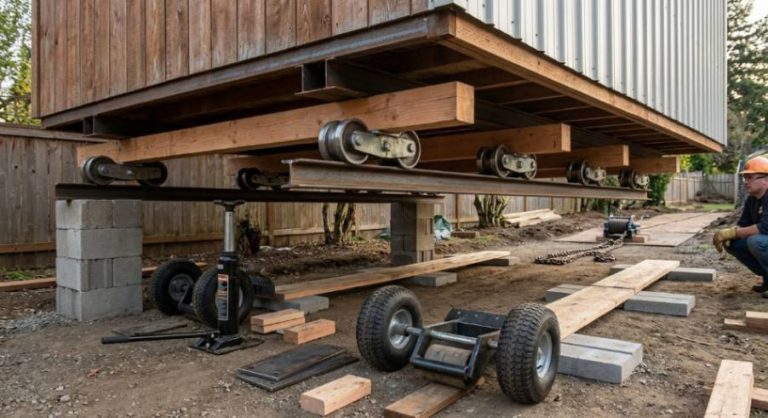
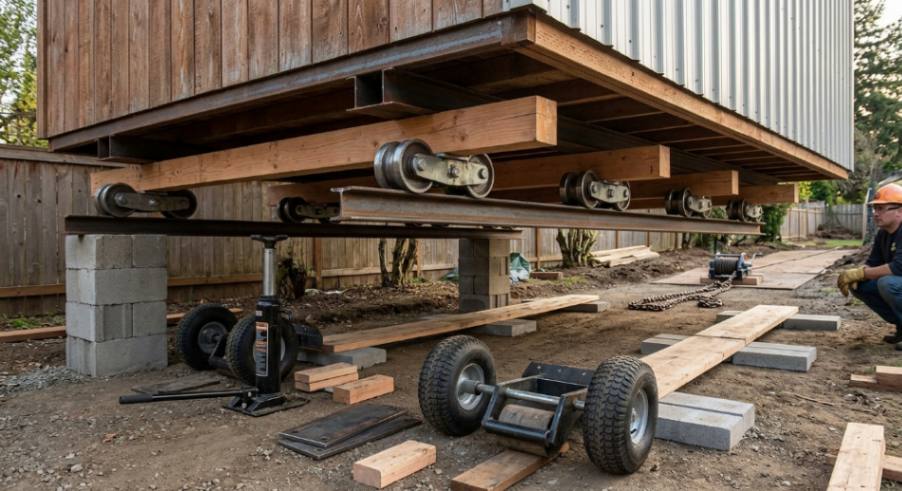
Rollers are the best fit for a medium shed with a solid floor. You jack it up, slide round pipes or timbers under the runners, and push. As the shed moves, the back roller comes free, and you carry it around to the front.
Lift slowly. Aosom suggests raising one corner at a time, keeping it even, and holding the shed up with wood blocks or cribbing while you work.
The same forum poster matched the roller to the ground. He used 1-inch iron pipes on pavement, round landscape timbers 4 to 6 inches thick on grass, and skids or plywood under everything on sloppy ground. This is his own experience, not a tested standard, but it lines up with what the other guides say.
His trick for the last few inches is worth borrowing. He used a doubled 2×4 over a block as a lever to walk the building over bit by bit. That’s much easier than trying to shove a shed sideways by hand.
Method 3: Skid It and Tow It
Skidding is faster than rolling and easier to get wrong. The shed slides on its runners, or on boards you add underneath, while a truck or tractor pulls it.
Go slowly. Backyard Oasis advises moving from the back first for clearance and towing gently over even ground so the frame doesn’t rack. Racking is when the walls lean out of square. Picture a cardboard box pushed at one corner.
Attach to the floor frame, never the walls. The forum poster’s crew made a hook from angle iron that grabbed the first few floor joists and gave them a low, solid pulling point. Stop every few feet and open the door. If it’s starting to stick, the frame is twisting.
Method 4: Put It on a Trailer (or Hire a Shed Mover)
Once the shed leaves your property, you need a trailer. It gets lifted onto a flatbed or rollback, strapped down, and driven over. For big sheds or long distances, Aosom mentions trailers, tractors and forklifts.
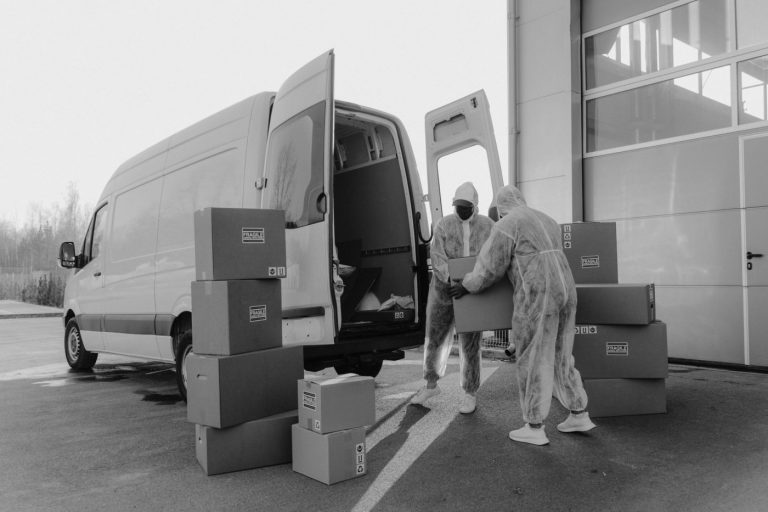
Most people hire help at this stage, and it’s usually worth it. Sheds can top 1,000 pounds, according to Angi, and shed movers show up with the trailer and lifting gear. A DoItYourself forum reply made a similar point: hiring a forklift or small loader for the lift is faster and safer.
Example (hypothetical): you’re moving 15 miles away and want to take a 10×12 wood shed. You’d need a trailer rated for the weight, something to lift the shed onto it, and, since the shed is 10 ft wide, probably a road permit. Once you add up the rentals, a shed mover may cost about the same, and they carry the risk.
When Is Taking It Apart the Better Call?
A rotten floor won’t survive being jacked up. And a shed bolted to a slab has to be unbolted anyway, so you’re halfway to dismantling it already. In those cases, taking it apart is the safer route. The DoItYourself reply suggested the same thing: dismantle it and rebuild it at the new place.
It takes longer, but nothing can suddenly fold on you. Photograph each wall before you take it down, and number the panels. Plastic and metal kit sheds are usually the easiest to take apart, since they were assembled from panels in the first place.
How Much Does It Cost to Move a Shed?
Angi puts professional shed moving at $200 to $1,000, with longer moves at the top of that range. Other sites give wider numbers because they include long-distance jobs:
| Source | Range | What it covers |
|---|---|---|
| Angi | $200–$1,000, avg. ~$500 | typical pro moves |
| HomeGuide | $300–$1,500 local; $3,000–$6,000 long distance | local = up to 50 miles |
| Airtasker | $119–$15,000 | includes hard access and permits |
| Backyard Oasis | $50–$1,000 DIY; $200–$2,500 pro | DIY = equipment only |
Big sheds cost the most. HomeGuide says they’re treated as oversized loads and often need a crane or forklift. Wood sheds also cost more to haul than metal ones because they weigh more.
To get a rough idea of a local job, you can use Angi’s rates. They list $1 to $2 per mile for moving companies and $25 to $50 an hour for local movers. For a 20-mile move with two movers working three hours:
- Mileage: 20 × $1 = $20, up to 20 × $2 = $40
- Labor: 2 × 3 = 6 hours, so 6 × $25 = $150, up to 6 × $50 = $300
- Total: about $170 to $340, not counting equipment, permits or disassembly
That’s an illustration, not a quote. Real prices depend on where you live, so get two or three quotes.
Replacing the shed costs far more. Angi puts a typical 120 sq ft shed at $1,800 to $18,000 installed. If yours is solid, moving it almost always wins.
Do You Need a Permit to Move a Shed?
Possibly, and it’s usually about where the shed ends up, not the move itself. A shed in a new spot is treated like a new shed there. The rules below are for the U.S.
Building Permit at the New Spot
The starting point is the International Residential Code. Section R105.2 exempts one-story detached accessory structures up to 200 sq ft from a building permit.
Many places set a lower limit. California’s residential code sets it at 120 sq ft. One state-by-state review puts New York at 144 sq ft, California and Washington at 120, and D.C. at 50, with Virginia at 256 and Pennsylvania at 1,000. I couldn’t check every state figure against its original source, so confirm yours with your local building office.
Your shed’s footprint decides which side of the line you’re on. A 10×12 is 10 × 12 = 120 sq ft. A 12×14 is 12 × 14 = 168 sq ft. It’s under the 200 sq ft model limit, but over a 120 or 144 sq ft one.
Zoning, Setbacks and HOA Rules
Being exempt from a building permit doesn’t mean being exempt from zoning. Setbacks, height limits and lot coverage still apply below the permit threshold, and many cities need a separate zoning permit. Setback distances come from the local zoning ordinance, not the building code.
This is where relocated sheds get people. The old spot was fine, but the new one sits a few feet too close to the fence. If you have an HOA, that’s another approval.
Electrical Hookups
Reconnecting power probably needs its own permit. In Kentucky, for example, electrical and plumbing connections need permits even on sheds that are otherwise exempt. Many places work this way, but check yours.
Road and Oversize Permits
On public roads, the question is width. Federal rules set 102 inches as the width limit for commercial vehicles on the National Network. Many states use the same number. Texas caps total width, including the load, at 102 inches.
102 ÷ 12 = 8.5 ft. A 10-ft-wide shed on a trailer is over that limit. HomeGuide notes that large sheds can need oversize-load permits, and some states also require a pilot car. Shed movers usually take care of this paperwork. Angi adds that some cities want a permit just to park the moving truck, around $10 to $80.
Mistakes That Wreck Sheds During a Move
The most common mistake is lifting unevenly. Raise one corner too far and the frame twists. Lift a little at each corner, going around the shed.
Next is pulling on the walls. Walls hold up a roof. They aren’t built to be dragged, and they lean or split when you try. Always pull from the floor frame.
The rest are planning mistakes, and they’re the most annoying because they’re easy to avoid. Moving a shed that’s too rotten to hold together. Not measuring the gate. Setting it down on ground that isn’t level. Placing it before checking setbacks. Each one takes a few minutes to prevent and can cost a weekend or more to fix.
FAQ
How long does it take to move a shed? Four people can usually carry a small shed in an afternoon, according to Backyard Oasis. Rolling or skidding a bigger one takes longer because you keep stopping to jack it up and move rollers. For a trailer move, it depends on distance and access. Can you move a plastic or metal shed the same way as a wood one? Mostly, yes. The risks are different. Aosom says plastic sheds are light but break easily, and metal sheds are tough but can bend. Kit sheds are often easier to take apart than to move whole. Is it cheaper to move a shed or buy a new one? Moving is usually cheaper. Pro moves typically run $200 to $1,000, while a new 120 sq ft shed can cost $1,800 to $18,000 installed, based on Angi’s figures. The exception is a shed so rotten it would need major repairs anyway. Who should I hire to move a shed? Look for a company that specializes in moving sheds or portable buildings. HomeAdvisor points to specialized shed-moving companies as the best choice. Ask whether they handle road permits and whether they’re insured.
If you’re moving a small shed across the yard, you’ll need a few friends, some 2x4s and a free afternoon. If it’s going down the road, get quotes before you rent anything. A shed mover might cost less than you expect.
Before you choose a method, measure the shed’s length and width, multiply them, and call your local building office with that number and the new spot in mind. It takes ten minutes and could save you from having to move the shed twice.
About the Author