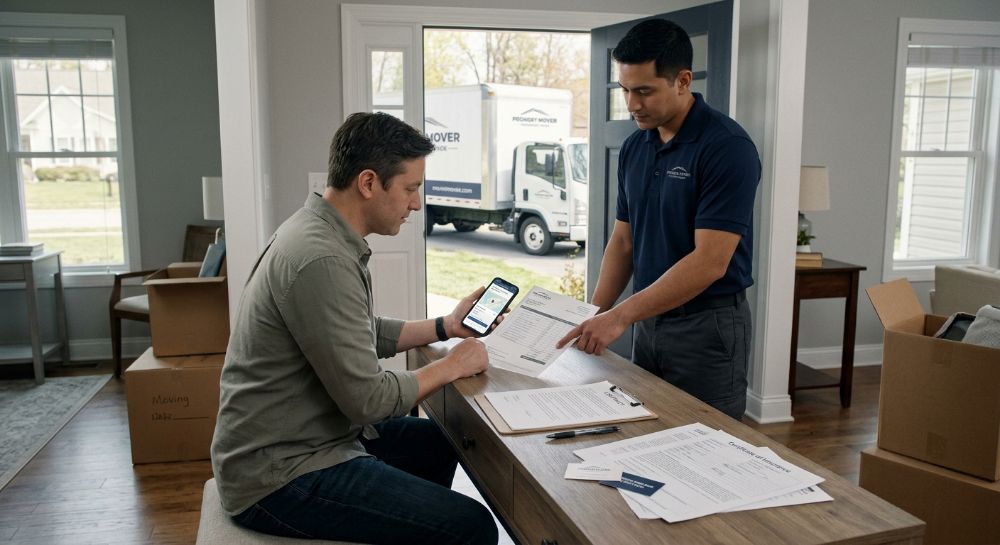
A reliable moving company has an active USDOT number, gives you a written estimate after seeing your items in person or on video, and never asks for full payment before delivery. A sketchy one skips one or more of those steps, usually the in-person estimate.
What Makes a Mover Legit?
Any company moving household goods across state lines needs a USDOT number and active FMCSA registration. That number should be on their website, their contract, and the side of the truck.
Licensed and insured local movers can show you a Certificate of Insurance without hesitation. If a company hesitates or changes the subject, that’s your answer.
How Do You Check FMCSA Registration?
Go to the FMCSA’s SAFER database and search the company’s name or USDOT number. Look for “authorized” status for household goods, not “revoked” or “inactive.”
Compare the legal name on that record against the name on your contract and the truck outside your house. A mismatch usually means a broker sold your move to a different carrier without telling you.
Sketchy Moving Company Red Flags
Watch for these signs before you sign anything:
- No physical address listed anywhere on the website or paperwork
- A verbal-only estimate, with no one coming to see your belongings
- A request for a large cash deposit before the move date
- Unmarked or rented trucks instead of branded company vehicles
- A generic phone greeting (“movers,” not a specific company name)
| Signal | Reliable mover | Sketchy mover |
| Estimate | In-home or video survey, written | Phone-only, vague |
| Deposit | Small or none, by card | Large, cash only |
| Contract | Binding, itemized | Verbal or incomplete |
| Payment | Due on delivery | Demanded upfront |
| Trucks | Branded, company name matches contract | Unmarked or rented |
Is a Low Estimate Always a Bad Sign?
Not always, but a bid dramatically below every other quote usually means one of two things. Either the company plans to add fees once your items are on the truck, or it’s a broker underbidding to win your deposit before handing the job to someone else.
Get at least three written estimates before you decide. If one comes in far below the rest, ask why in writing. For typical pricing ranges to compare against, see how much movers cost in 2026.
What Should a Moving Contract Include?
A proper contract states whether the estimate is binding or non-binding, lists the total cubic footage or weight, and spells out the delivery window. It should also name the actual carrier, not just a booking company.
Non-binding estimates can change based on final weight. Binding estimates can’t, aside from add-ons you approve in writing. Ask which one you’re signing before you agree to anything. If you’re shipping fragile or high-value pieces, confirm the contract lists valuation coverage for them specifically; our guide on how to move antique furniture safely covers what to ask for.
What If You Already Hired a Bad Mover?
If your items are being held for more money than quoted, known in the industry as a hostage-load situation, contact FMCSA’s complaint line and local police. In one 2024 crackdown, FMCSA investigated movers across 17 states after a spike in these complaints.
Document everything in writing, including texts and the original estimate. That paper trail matters more than a phone call once a dispute reaches a complaint filing.
Should You Check Reviews Too?
FMCSA registration proves a company is legal. It doesn’t tell you if they’re good at the job. Check Google, Yelp, and the BBB separately, and read the one-star reviews first, since that’s where hostage-load complaints and hidden fees usually surface. Reviews also tell you how careful a crew is with packing, which matters if you’re handling it room by room yourself first; see our room-by-room packing guide for what to prep before the crew arrives.
Membership in the American Moving and Storage Association’s ProMover program is a decent secondary signal. It’s not a legal requirement, but companies that bother with it tend to have fewer of the address and contract problems listed above.
Local movers versus national chains isn’t really a trust question on its own. A small local company with a clean FMCSA record and years of reviews can be more reliable than a big name that resells your job to a subcontractor.
FAQ
What is the easiest way to check if a moving company is legit? Search its USDOT number on the FMCSA’s SAFER database and confirm the operating status reads active, not revoked.
Do professional movers ask for full payment upfront? No. Legitimate movers collect payment on delivery, sometimes with a small deposit beforehand, not the full balance in advance.
How do I know if a moving company is licensed and insured? Ask for their USDOT number and a Certificate of Insurance, then verify both independently rather than taking their word for it.
What should I do if I suspect a scam before moving day? Cancel in writing, keep a record of all communication, and rebook with a company you’ve verified through FMCSA directly.
Ask each of the three estimators the same question before you decide: what happens if my move date changes. A reliable company gives you a real answer with a rebooking fee attached. A broker or shell operation tends to go vague here, since they don’t actually control the truck that shows up. Cutting down your inventory before any of this starts also limits what a bad actor could hold hostage in the first place; our KonMari decluttering guide for movers walks through that process.
About the Author