

Ask ten people who’ve moved with a dog what went wrong, and most of them won’t say the drive. They’ll say the paperwork. A health certificate that expired three days before the flight. A pet reservation that filled up before they thought to book it. The actual travel usually isn’t the hard part. The timing around it is.
So here’s the short version: pick your transport method first, get your vet visit timed to match your certificate’s validity window, and keep your pet’s routine as normal as you can manage on both ends. Everything else is detail work.
Pick the transport method before anything else
This decision drives everything downstream. It decides which health certificate you need, how far ahead you have to book, and what the whole thing costs. Wait too long to figure this out, and you’ll end up making decisions under pressure, which is exactly when a pet move turns stressful.
| Method | Best for | What to plan for |
| Driving | Most dogs, distances under 1,500 miles | Frequent breaks, a secured crate or harness, pet-friendly lodging booked ahead |
| Amtrak | Small pets only | 20-pound combined pet-and-carrier limit, 7-hour trip cap, limited routes |
| Flying (cabin) | Small pets under airline weight limits | Carrier must fit under the seat; airlines cap how many pets ride per flight |
| Flying (cargo) | Larger dogs when driving isn’t practical | Many airlines won’t take flat-faced (brachycephalic) breeds like bulldogs or pugs in cargo at all |
| Professional pet shipper | Multiple pets, long hauls, anxious animals | Pricier, but someone else handles the paperwork and the climate control |
A flat-faced dog might not have a cargo option at all, so check the airline’s breed restrictions before you set a date. If you want a deeper comparison of driving against flying against shipping, this transit guide lays out the tradeoffs in more depth. There’s also a good rundown on flying with a pet if that’s the route you’re leaning toward.
Can a 60-pound dog ride Amtrak?
No, and this trips up a lot of people who assume trains are the easy option. Amtrak’s pet policy caps combined pet-and-carrier weight at 20 pounds, and the carrier has to fit under the seat for the whole trip. A 60-pound dog is nowhere close to that limit.
The one exception is a trained service dog, which isn’t subject to the weight rule or the pet policy at all. Emotional support animals don’t get that pass. Amtrak treats them the same as any other pet, weight limit included.
Even for pets that do qualify, the rules keep going: reservations cap out at 7 hours of travel, only five pets are allowed per train total, not per car, and routes like the Auto Train, the Adirondack, the Maple Leaf, and the Canada-bound Cascades service don’t allow pets at all. For a dog anywhere near 60 pounds, that leaves driving, flying, or a ground shipping service as the real options.
What does cross-country pet transport actually cost?
This varies more than people expect, mostly because “shipping a pet” can mean five different things.
Driving it yourself is the cheapest by far, since you’re mainly paying for gas, food, and lodging. Amtrak, for pets small enough to qualify, runs about $25 to $30 on top of your own ticket. Flying in-cabin with a small pet usually adds $95 to $250 in airline fees. Cargo flights for larger dogs, where the airline even allows it, typically run $300 to $1,000 or more before you’ve bought your own seat.
Professional ground transport for a genuine coast-to-coast move usually lands between $800 and $2,500, and it climbs from there for bigger dogs or routes with multiple stops; some quotes for large dogs cross $3,000. Then there’s the health certificate, which most states require regardless of how you travel: budget $50 to $200 for the exam and paperwork.
One quirk worth knowing: shorter regional trips often cost more per mile than the long hauls. A driver still has fuel and time costs to cover even on a 200-mile trip, so the per-mile rate on that route can end up higher than a 2,000-mile cross-country run. If you’re trying to keep costs down, booking 4 to 8 weeks out and choosing a shared-ride ground transport option, where your pet rides alongside others heading the same direction, tend to make the biggest difference.
Do you need a health certificate to cross state lines with a pet?
Almost always, yes. A Certificate of Veterinary Inspection, signed off by a USDA-accredited vet, confirms your pet is healthy and current on vaccinations. Every state that requires one enforces a specific window for how long it stays valid, and this is where the timing mistake happens.
Certificates are typically good for 10 days if you’re flying and up to 30 days if you’re driving. Get the exam too early, and you’ll be redoing it during moving week. A family relocating from Texas to Oregon in mid-2026 with two cats scheduled the exam 6 days before the flight, inside the window but with enough slack to redo it if the vet flagged anything.
How long of a car ride is too long for a dog?
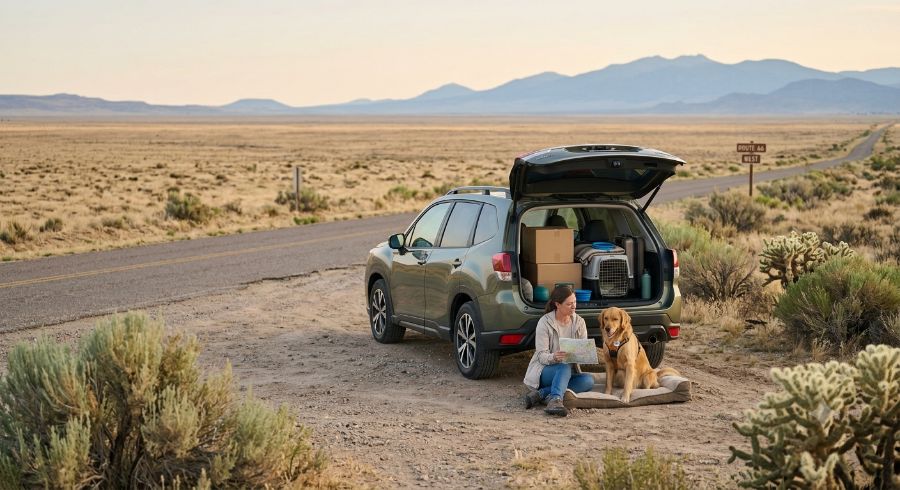
Most vets land on the same range: a break every 2 to 4 hours, 15 to 30 minutes each, with water offered at every stop. Puppies and senior dogs need to stop more often, sometimes every hour, since they have less bladder control than a healthy adult dog.
As a general ceiling, plan for around 6 to 7 hours of actual driving per day with a dog in the car. Past that, most dogs, and most drivers, start to fray. How well a dog handles it comes down to the individual animal. If yours gets carsick or anxious in the car, shorten the stretches between stops and use the break time for a short walk and some calm attention, not just a bathroom trip. A cross-country drive with a dog will almost always take longer than the same trip solo, just because of how often you’re stopping.
What the timeline should look like
Eight weeks before the move, lock in the transport method, and if you’re flying or taking Amtrak, book your pet’s spot right away since both cap how many pets they’ll take. At 4 weeks out, schedule the vet visit so it lands inside your certificate’s validity window, and check whatever import rules your destination state has. Two weeks out, update the microchip contact info, refresh the ID tags, and start packing a pet essentials bag: food, meds, leash, litter, the usual.
On moving day itself, keep your pet somewhere quiet, away from the movers, the open doors, and the general chaos. Once you’re in the new place, try to keep feeding times and walk schedules identical to what they were before the move, at least for the first week.
If your pet gets anxious during the move
Routine does more for a stressed pet than any gadget you’ll find in a pet store. Same feeding times, same walk schedule, a blanket or toy that smells like home. If your pet already has a history of bad travel anxiety, bring it up with your vet at the same appointment where you get the health certificate. Don’t leave it as an afterthought for the week of the move.
Bottom line
A cross-country move with a pet goes smoothly when three things get planned together instead of separately: the transport method, the health certificate timing, and the rest of your moving checklist. Whether that means a string of car breaks for a dog too big for Amtrak, or a ground shipper for a longer haul, the paperwork and the routine matter as much as the actual trip.
About the Author