Photo: kaboompics.com, Pexels (Pexels License)
What is the first step before I pack a single book?
Sort the collection and decide what does not need to move. Packing a book you will never open again wastes a box, adds weight, and costs you money on a long-distance move. A home library often holds volumes that have outlived their purpose: outdated travel guides, old textbooks, and mass-market paperbacks with yellowed pages and broken spines.
Pull every book off the shelf and make three piles: keep, donate and recycle. Be practical. A book with a cracked binding or visible mold should not travel; mold spores spread to other volumes inside a sealed box. Local libraries, used bookstores and thrift shops take clean, readable books. Paperbacks in poor condition go into the recycling bin, not a moving box.
You will likely remove 15 to 25 percent of the shelf count. That means fewer boxes to buy, a lower total weight and less time spent wrapping and lifting. For a collection of 500 books, cutting 100 volumes can eliminate four or five small book boxes and keep the moving quote in a lower weight bracket.
How do I sort a home library for a move?
Librarians use a simple three-category method that turns a wall of books into manageable stacks in an afternoon. Decide on keep, donate, or store for each volume and do not second-guess yourself. Move only the books you will actually read, reference, or treasure in your new home.
Handle rare or sentimental volumes first and set them aside in a dedicated keep pile so they never get mixed into the general sort. A book you have not opened in five years and feel no attachment to belongs in the donate box. Paperbacks with yellowed pages and cracked spines rarely survive a move and are seldom worth the effort.
- Pick up each book and decide in ten seconds, keep, donate, or store, then place it in the corresponding box without reopening it.
- Set a firm limit for the keep category, such as two standard small book boxes, and stick to it as you sort.
- Photograph rare editions, signed copies, and family heirloom volumes before packing so you have a record for insurance.
- Group store items by season or project, holiday cookbooks, academic journals, and label the box with a planned retrieval date.
- Bag musty or damp books in a sealed plastic zip bag and quarantine them from the main sort until they dry completely.
- Deliver the donate boxes to a library sale or charity shop within a week so they do not accidentally follow you to the new house.
Sorting before the move cuts packing time and the weight the crew carries, which keeps your final bill lower. A disciplined sort means your new shelves hold only books that earn their place.
What packing materials work best for books?
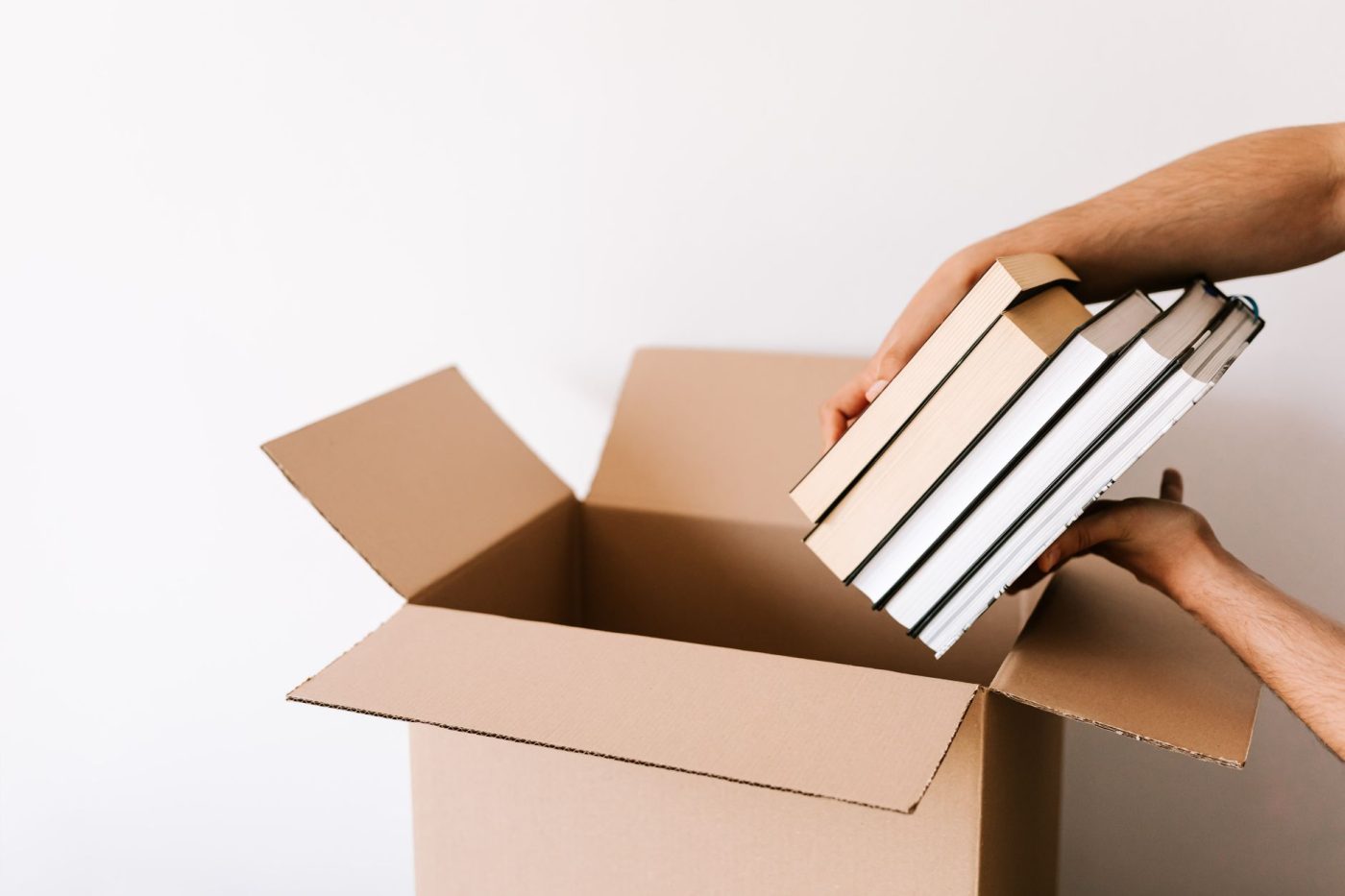
Small double-wall cardboard boxes, often labeled as 1.5 cubic foot or “book cartons,” handle the weight of paper far better than standard single-wall boxes or large plastic bins. A box filled with books becomes heavy fast, and double-wall construction resists buckling when movers stack it. Plastic bins seem sturdy, but their rigid sides do not absorb vibration the way cardboard does, so hard knocks transfer directly to the spines.
Box size matters as much as the material. A carton measuring roughly 12 by 12 by 15 inches holds a manageable weight when full and prevents the crushing that happens when books shift inside an oversized container. Oversized boxes invite overpacking, which strains seams and risks a blowout on moving day.
- Double-wall cardboard boxes rated for at least 44 lb edge crush test hold their shape under stack pressure.
- 1.5 cubic foot cartons keep a full box under 40 lb, a safe limit for one person to carry.
- Specialty book cartons with reinforced handles and taped bottoms speed up packing and reduce hand fatigue.
- New, undamaged boxes give predictable strength; reused boxes may have softened corners from humidity.
- Avoid grocery store boxes and thin single-wall cartons that bulge and tear under book weight.
How do I pack hardcovers, paperbacks and large art books?
Each format needs a specific orientation inside the box to prevent warped covers and cracked spines. Standard hardcovers travel best standing upright with the spine against the box wall, just as they sit on a shelf. Pack them snugly so they support each other without sliding, but never force a book in if it bends.
Trade paperbacks and mass-market paperbacks can be packed flat and stacked, because their flexible covers do not put pressure on the binding when the book lies down. Place the heaviest paperbacks at the bottom of the stack. Large art books, coffee table books and atlases must lie completely flat, never upright. Their weight can tear the text block from the spine if they stand on end during a bumpy ride.
Follow these rules for every box of books:
- Fill any gap wider than two fingers with crumpled packing paper so books cannot shift in transit.
- Keep the total weight of a small book box (1.5 cubic feet) under 40 lb; a standard medium box under 50 lb.
- Place a sheet of clean packing paper between flat-stacked books with glossy or foil-stamped covers to prevent them sticking together in heat.
- Line the bottom of the box with a layer of crumpled paper before you load the first book, and add a cushion layer on top before sealing.
- Never pack books with the spine facing up, because the pages will pull away from the binding as the truck vibrates.
- Mark every box clearly with "BOOKS" and an arrow showing the upright orientation for hardcover boxes.
How do I protect books from moisture during a move?
Books are surprisingly absorbent, and moisture is one of the quickest ways to ruin a collection. High humidity can swell pages and warp covers, while direct contact with water causes immediate, often irreversible damage. Create a dry microclimate inside each box and keep the boxes away from any surface that might get wet.
Line the inside of every book box with a heavy-duty plastic bag or a sheet of polyethylene before packing. Tuck the plastic over the top as the final layer, not just a liner on the bottom, so the contents are fully wrapped. Toss two or three silica gel packets into each box before sealing it to absorb any ambient moisture trapped inside. Do not use packets that have been sitting out in the open for weeks; they lose effectiveness quickly. For a move during a rainy season, replace the silica gel packets with a fresh set the morning the truck is loaded.
On the truck, never place book boxes directly on the floor, especially near the roll-up door where rainwater can seep in. Ask the crew to set them on pallets or atop a row of furniture pads. If any part of the move involves a basement, garage, or an uninsulated storage unit, even for a few hours, put a waterproof tarp under the stack of boxes and keep them at least six inches away from concrete walls where condensation forms.
Should I pack books myself or let the movers do it?
Pack a home library yourself when you have fewer than 15 standard banker’s boxes and at least two weeks before moving day. The work is repetitive but not difficult, and doing it yourself lets you weed out titles you no longer want and keep your shelving order intact. You also avoid the labor charge that a full-service crew adds for packing, which typically runs as a separate line item on your estimate.
Hand the job to professional movers when you face a tight timeline, a collection that fills an entire room, or a flight of stairs you would rather not climb with 40-pound boxes. A trained crew packs a large library in a single morning using uniform boxes and methods that meet the carrier’s liability requirements. If you go this route, ask the foreman whether the crew will wrap dust jackets separately and double-box rare volumes; not every team does this unless you request it.
Clear labels keep books safe no matter who packs them. Mark every box with the destination room and a short content note such as “Cookbooks, top shelf” or “Paperbacks, living room.” Add a directional arrow and the word “FRAGILE” on two adjacent sides. When movers can read a box’s place and priority without opening it, the box is less likely to end up stacked under heavier freight or left in the wrong room.
FAQ
Can I pack books in suitcases or rolling luggage?
Yes, a suitcase with sturdy sides works well for heavy books. Keep the total weight under 50 lb so the handles and wheels do not break. Pad the bottom and sides with a towel and do not stack books above the rim where they would press against the lid.
How many books fit in a standard small moving box?
A 1.5 cubic foot box typically holds 25 to 35 average hardcovers. That box will weigh around 40 to 50 lb when full. Resist the urge to use a larger box; a box that is too heavy is the most common reason books get dropped or boxes tear open.
What is the best way to pack rare or antique books?
Wrap each volume in acid-free tissue, then in a layer of bubble wrap with the bubbles facing outward. Place the book flat in a box that fits it snugly and fill any gaps with crumpled packing paper so nothing shifts. Mark the box as fragile and keep it out of direct sunlight and away from the truck walls.
Do I need climate-controlled storage for books between moves?
If the gap between move-out and move-in is longer than a week, or if you are moving during a humid summer, climate-controlled storage is worth the extra cost. Books stored in a hot attic or a damp garage can develop warped pages, mold or a musty smell that is almost impossible to remove.
About the Author